
2026 Harley-Davidson® Street Glide® near Greenville, SC
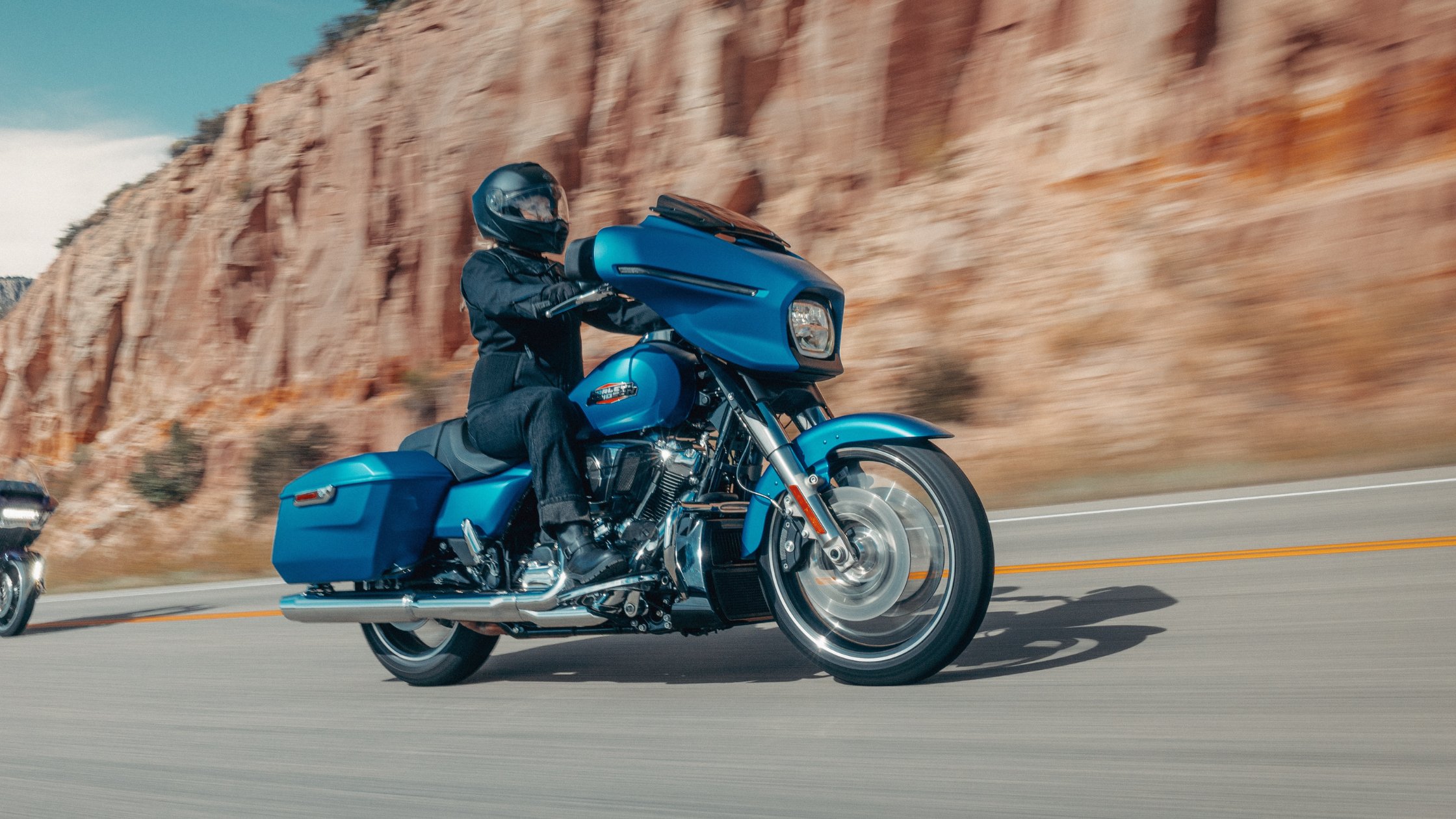
First introduced in 2006, the Harley-Davidson® Street Glide® established a new direction for large-displacement touring motorcycles by combining a fixed Batwing fairing, a low-profile silhouette, and long-distance engineering focused on stability and control. Over nearly two decades, the model has evolved through incremental technical refinements rather than radical redesigns. Each generation has preserved the fundamental touring architecture while integrating updated powertrain components, electronics, and rider-assist systems. The 2025 Harley-Davidson® Street Glide® reflects the most advanced execution of this platform to date and serves as a clear reference point for the forthcoming 2026 Harley-Davidson® Street Glide®.
The 2025 Harley-Davidson® Street Glide® remains defined by its balance of sustained highway performance, rider interface technology, and chassis stability. The 2025 Harley-Davidson® Street Glide® highlights measurable improvements in thermal management, electronic integration, and suspension adaptability, all grounded in specifications intended for extended use across varied riding conditions.
Milwaukee-Eight® 117 Engine Architecture and Output Characteristics
The 2025 Harley-Davidson® Street Glide® is powered by the Milwaukee-Eight® 117 V-twin engine, a large-displacement power unit engineered specifically for touring demands. The engine produces 105 horsepower and 130 ft-lb of torque, figures that emphasize sustained pulling power rather than peak engine speed. Torque delivery is optimized for low- and mid-range operation, supporting controlled acceleration during highway merging, two-up riding, and fully loaded travel.
Liquid-cooled cylinder heads are incorporated to manage heat more efficiently in high-load and high-temperature environments. Cooling is handled through a centrally mounted radiator that integrates into the chassis without altering external proportions. This configuration improves heat dissipation around the exhaust valve area, supporting consistent combustion performance and reducing thermal transfer toward the rider area.
The intake system is designed with increased internal volume to support improved airflow. This design enhances throttle response consistency and supports stable power delivery during prolonged operation at highway speeds. Combined with the engine’s four-valve-per-cylinder layout and dual spark plugs, combustion efficiency remains stable across varying throttle inputs.
Transmission Behavior and Power Delivery Management
Power from the Milwaukee-Eight® 117 is transferred through a six-speed transmission calibrated for touring use. Gear ratios are selected to reduce engine speed during cruising while maintaining sufficient torque multiplication for passing and incline riding. Clutch engagement characteristics are tuned for predictable modulation, supporting smooth launches under load and controlled low-speed maneuvering.
Electronic throttle control interfaces with the ride mode system to adjust throttle response curves. This integration allows the engine’s output characteristics to adapt based on the selected ride mode without altering mechanical components. The result is a consistent powerband that remains accessible across different riding conditions.
Frame Geometry and Touring Stability
The 2025 Harley-Davidson® Street Glide® chassis is designed around a steel backbone frame that prioritizes straight-line stability and load-bearing capability. The fixed fairing design contributes to predictable steering behavior by isolating aerodynamic loads from the front suspension. This configuration reduces steering input variation at highway speeds and improves directional stability during crosswinds.
Weight distribution is managed to support balanced handling when carrying passengers or luggage. The chassis geometry supports controlled turn-in while maintaining composure through long sweepers and uneven road surfaces. Structural rigidity is tuned to limit flex under braking and acceleration without compromising ride comfort.
Rear Suspension Adjustability and Load Adaptation
Rear suspension is managed through hand-adjustable rear shocks that allow preload changes to be made without tools. This system enables quick adaptation to varying payloads, including passenger weight and cargo. Proper preload adjustment maintains suspension travel within its intended range, preserving ride quality and handling characteristics.
Suspension tuning is focused on damping consistency across long-distance operation. The rear system supports controlled rebound and compression behavior, reducing chassis movement during highway transitions and surface irregularities. This contributes to reduced rider fatigue over extended riding periods.
Wheel Dimensions and Road Contact Strategy
The 2025 Harley-Davidson® Street Glide® utilizes a 19-inch front wheel and an 18-inch rear wheel, a combination selected to balance stability and steering response. Larger front wheel diameter improves directional control at speed, while the rear wheel size supports traction under acceleration. Contrast-cut wheel construction reduces unsprung mass while maintaining structural integrity.
Tire profiles are matched to the chassis geometry to ensure predictable contact patch behavior during cornering and braking. The Tire Pressure Monitoring System continuously monitors inflation levels and communicates deviations through the instrument display. Proper tire pressure supports consistent handling response, braking efficiency, and tire longevity.
Batwing Fairing Design and Aerodynamic Optimization
The Batwing fairing remains a defining structural element of the 2025 Harley-Davidson® Street Glide® and is engineered using computational fluid dynamics to improve airflow management. The fairing shape directs wind around the rider area, reducing buffeting and minimizing pressure differentials at highway speeds. Aerodynamic refinement supports rider stability without relying on adjustable external components.
LED signature lighting is fully integrated into the fairing structure. This integration improves forward visibility while maintaining a unified aerodynamic surface. The lighting system delivers consistent illumination patterns that support night riding and reduced-light conditions without increasing drag.
Seating Geometry and Rider Positioning
The one-piece seat design supports long-duration riding through contoured foam density and consistent load distribution. The laden seat height of 26.4 inches allows riders to maintain secure footing at stops while preserving ground clearance during cornering. Seat geometry aligns the rider with the handlebar and foot control positions to support neutral posture during extended travel.
Rider positioning is optimized to reduce reach strain and maintain control leverage. The seating configuration complements the chassis geometry, supporting stable weight transfer during acceleration, braking, and cornering transitions.
12.3-Inch TFT Display and Control Integration
A 12.3-inch color TFT touchscreen display serves as the primary rider interface. The display provides access to navigation, audio, ride mode selection, and system status information. Screen brightness and resolution are calibrated for visibility in varying light conditions, including direct sunlight.
Touchscreen responsiveness supports quick menu navigation without excessive input. The interface consolidates multiple control functions into a single display, reducing the need for separate instrumentation and simplifying cockpit layout. System alerts and vehicle data are presented in a structured format to minimize distraction.
Ride Modes and Electronic Configuration Control
The 2025 Harley-Davidson® Street Glide® includes three factory ride modes: Road, Sport, and Rain. Each mode adjusts throttle response, traction control sensitivity, and braking behavior. Road mode provides balanced output for general riding conditions. Sport mode increases throttle response for more immediate power delivery. Rain mode reduces throttle sensitivity and increases electronic intervention to support traction on low-grip surfaces.
A customizable ride mode allows riders to adjust parameters to suit individual preferences. Electronic systems work in coordination to maintain consistent behavior across varying conditions without mechanical changes.
Audio System Engineering for Touring Use
The fairing-mounted audio system is powered by a 200-watt, four-channel amplifier rated at 50 watts per channel. Speaker placement is engineered to project sound toward the rider while minimizing interference from wind noise. Audio output maintains clarity across frequency ranges during sustained highway operation.
System integration allows audio controls to be managed through the TFT display interface. This integration reduces the need for additional controls and maintains a streamlined cockpit environment.
Rider Safety Enhancements and Braking Systems
The 2025 Harley-Davidson® Street Glide® is equipped with an extensive suite of Rider Safety Enhancements designed to support control during braking, acceleration, and deceleration. Anti-lock Brake System functionality prevents wheel lock during heavy braking. Electronic Linked Braking distributes braking force between the front and rear wheels to improve stopping efficiency.
Traction Control System functionality limits rear-wheel slip during acceleration. The Drag-Torque Slip Control System reduces rear-wheel lock during abrupt deceleration or downshifting. Vehicle Hold Control maintains brake pressure during stops on inclines to prevent rollback during launches.
Cornering-enhanced systems modify braking and traction behavior based on lean angle. Cornering ABS, Cornering Electronic Linked Braking, Cornering Traction Control, and Cornering Drag-Torque Slip Control adjust system responses to maintain directional stability while cornering.
Customization Compatibility and Platform Continuity
The 2025 Harley-Davidson® Street Glide® platform supports a wide range of factory and accessory customization options without altering its fundamental mechanical layout. Paint finishes, trim variations, seating options, and performance accessories can be integrated while maintaining compatibility with the base chassis and electronics.
This adaptability allows the platform to remain consistent across model years while supporting individual configuration preferences. The 2025 Harley-Davidson® Street Glide® demonstrates how incremental updates can be layered onto an established structure without compromising reliability or function.